 Charterbend
Front sheet · Analysis · The System
The System
The asset thresholds that change the rules
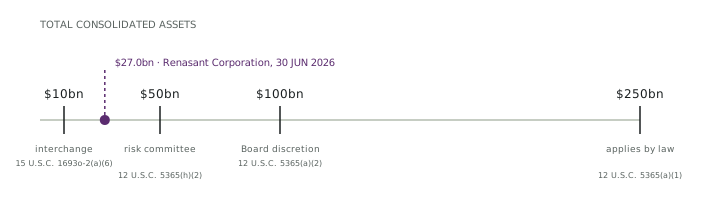
American banking law changes shape at round numbers. Four of them — ten billion, fifty billion, one hundred billion, two hundred and fifty billion — decide which rules reach an institution, and one of them moved without leaving the section.
A threshold is a sentence with a number in it. It does not describe a bank, measure a risk or grade a business; it decides which paragraph of a statute reaches which institution, and it does so by comparing one reported figure with one printed figure. Everything that follows from that comparison — an obligation that attaches, an exemption that lapses — follows mechanically, which is why the exact words and the exact figure matter more here than almost anywhere else in banking law.
This page reads four such lines at their own sections, sets them out side by side, and measures one holding company against them. It quotes each figure as the statute prints it, with every zero, because a threshold written as “ten billion” in prose and as $10,000,000,000 in the Code is the same amount of money and not the same quotation.
Ten billion: the interchange line
The first line sits in the electronic fund transfer statute, in the subsection whose heading reads “Reasonable Interchange Transaction Fees”. That subsection governs what an issuer may receive or charge for an electronic debit transaction.
UNITED STATES CODE · 15 U.S.C. 1693o-2 · law.cornell.edu
The line itself is an exemption rather than an obligation, and it is phrased in the negative: “This subsection shall not apply to any issuer that, together with its affiliates, has assets of less than $10,000,000,000”.
UNITED STATES CODE · 15 U.S.C. 1693o-2 · law.cornell.edu
Three features of that sentence are worth marking. It measures the issuer together with its affiliates, not the issuer alone. It uses “less than”, so the exemption is lost at the figure and not above it. And it is written as a carve-out from a subsection that otherwise applies, which means that crossing the line does not add a new rule to the statute book — it removes the sentence that had been keeping an existing rule away.
UNITED STATES CODE · 15 U.S.C. 1693o-2 · law.cornell.edu
One hundred billion: discretion
The second and third lines live in one section of Title 12 that deals with enhanced prudential standards. At the lower of the two, the Board of Governors may apply those standards at its discretion, to companies with “total consolidated assets equal to or greater than $100,000,000,000”. The statute sets no upper bound on that discretion.
UNITED STATES CODE · 12 U.S.C. 5365 · law.cornell.edu
Discretion is the operative word, and it is the reason this line behaves differently from the other three on the page. Crossing it does not itself impose a standard. It places a company inside the range in which a standard may be imposed, and what happens next is a matter for the Board rather than for arithmetic.
Two hundred and fifty billion: obligation
At the higher line, the same section drops the discretion. The standards apply by law to “bank holding companies with total consolidated assets equal to or greater than $250,000,000,000”.
UNITED STATES CODE · 12 U.S.C. 5365 · law.cornell.edu
Both figures use the same comparison — equal to or greater than — so both are thresholds that bite at the number itself, not a dollar above it. The difference between the two is not the arithmetic but the verb: may, at the lower figure; does, at the higher one.
The line that moved rather than vanished
Anyone reading about the 2018 amendments to this section will meet the claim that the fifty-billion threshold was removed. It was not. The amendment note attached to the section records what actually happened to it in the introductory provisions: “Pub. L. 115–174, § 401(a)(1)(A), substituted “$250,000,000,000” for “$50,000,000,000” in introductory provisions.”
UNITED STATES CODE · 12 U.S.C. 5365 · law.cornell.edu
Substituted, not struck. And a fifty-billion threshold is operative in the same section today, attached to a different obligation: “The Board of Governors shall issue regulations requiring each bank holding company that is a publicly traded company and that has total consolidated assets of not less than $50,000,000,000 to establish a risk committee”.
UNITED STATES CODE · 12 U.S.C. 5365(h)(2)(A) · law.cornell.edu
The same 2018 Act worked on that subsection too: at § 401(a)(4) it raised a ten-billion line to fifty billion. So within one section, one Act moved a figure up in one place and raised a different figure to that same value in another. A number can leave one paragraph and arrive in the next, and the sentence “the threshold was removed” is exactly the sentence that hides the move. This publication’s own file asserted the removal once, in the rule that was supposed to prevent the error, and an independent re-reading of the section caught it.
| Figure in the statute | Section | What the quoted text does | Comparison used |
|---|---|---|---|
| $10,000,000,000 | 15 U.S.C. 1693o-2 | Withholds the interchange subsection from a smaller issuer, measured with its affiliates | less than |
| $50,000,000,000 | 12 U.S.C. 5365(h)(2)(A) | Requires regulations for a risk committee at a publicly traded holding company | not less than |
| $100,000,000,000 | 12 U.S.C. 5365 | Opens the range in which the Board may apply enhanced prudential standards | equal to or greater than |
| $250,000,000,000 | 12 U.S.C. 5365 | Applies those standards by law | equal to or greater than |
United States Code, 15 U.S.C. 1693o-2 and 12 U.S.C. 5365, both read September 22, 2026. Figures are reproduced with the digits the sections print. law.cornell.edu
One company, measured against the lines
A threshold is only half a comparison. The other half is a reported figure, and a reported figure has a level, a source and a date. The holding company in this publication’s principal file reported total assets of $27,004,999,000 at June 30, 2026, as tagged in its own machine-readable data.
SEC XBRL COMPANY CONCEPT · CIK 0000715072 · data.sec.gov
That figure is not a one-quarter aberration. Across the four most recent reported quarters the tagged values are 26,726,165,000; 26,751,426,000; 27,107,274,000; and 27,004,999,000 — each of them above the ten-billion line, and each of them far below the next figure on the list.
SEC XBRL COMPANY CONCEPT · CIK 0000715072 · data.sec.gov
| Line | Figure in the statute | Reported at June 30, 2026 | Above the figure? |
|---|---|---|---|
| Interchange exemption | $10,000,000,000 | $27,004,999,000 | Yes |
| Risk committee regulations | $50,000,000,000 | $27,004,999,000 | No |
| Standards the Board may apply | $100,000,000,000 | $27,004,999,000 | No |
| Standards that apply by law | $250,000,000,000 | $27,004,999,000 | No |
Thresholds from 15 U.S.C. 1693o-2 and 12 U.S.C. 5365; reported total from the filer’s own tagged data at CIK 0000715072, period ended June 30, 2026. All read September 22, 2026. data.sec.gov
The risk-committee line carries a second condition as well as a dollar figure — the company must be a publicly traded company — but nothing turns on it here, because the comparison fails at the dollar figure first.
Which number goes on which side of the line
There is a trap in that table, and it is the most common error in this whole subject. The bank and the holding company are different entities with different balance sheets, and their totals are different numbers. The FDIC register reports the bank-level figure as $26,986,725 thousand; the SEC data reports the holding-company figure as $27,004,999,000. They are close, they are not the same, and one may not be substituted for the other.
FDIC INSTITUTION REGISTER · CERT 12437 · api.fdic.gov
The distinction is not pedantry, because the statutes themselves pick sides. The language quoted from 12 U.S.C. 5365 speaks of bank holding companies and their total consolidated assets; the language quoted from 15 U.S.C. 1693o-2 speaks of an issuer together with its affiliates. Neither phrase is satisfied by reaching for whichever total is closest to hand. Why the two levels exist at all, and which register knows what about each, is set out in the structure of the corporation; the bank-level figure quoted above comes from a different register again, described in Call Reports.
What a threshold is not
Four closing limits, each of them a rule this page has followed rather than an aside.
A threshold is not a measure of risk. It decides which rules apply, which is a different sentence from any sentence about how an institution is doing. Nothing above should be read as saying that an institution below a line is safer, weaker, better or worse than one above it, and nothing above says it.
The obligations attaching at each line are not enumerated beyond the quoted text. Enhanced prudential standards, in particular, are described here only in the words the section uses — standards the Board may apply, and standards that apply by law — because the further content of those standards sits in documents this page has not read at their own addresses.
The figures expire. Asset totals are re-checked against the thresholds quarterly, and the statutory dollar figures are re-checked when the sections are amended. The date on this page is the date both checks were last performed, and a threshold piece without such a date is a liability rather than a reference.
And the arithmetic is the whole of the argument. Four printed figures, one reported total with a level and a date, four comparisons. Everything else about an institution lives in other documents, and this one does not borrow from them.
Sources
- United States Code, regulation of interchange transaction fees. 15 U.S.C. 1693o-2 law.cornell.edu
- United States Code, enhanced supervision and prudential standards, with its amendment notes. 12 U.S.C. 5365 law.cornell.edu
- SEC company concept data, total assets as tagged by the filer. CIK 0000715072 · us-gaap:Assets data.sec.gov
- FDIC institution register, institution-level record. CERT 12437 api.fdic.gov
Charterbend does not provide investment advice. It does not rate, recommend or value any security or institution, and nothing here is an offer or a solicitation to buy or sell anything.