 Charterbend
Front sheet · Analysis · The Company
The Company
How Renasant Corporation is organized
A bank that can be walked into is not the entity whose shares trade. This piece climbs the structure from the branch upward and names, at each step, the public register that records it.
The bank, and the state that chartered it
The entity behind the sign on the door is a bank with a name, a city and a number. The FDIC’s institution register returns all three: the name is Renasant Bank, the city is Tupelo, the state is Mississippi, and the certificate is 12437. [1]
FDIC INSTITUTION REGISTER · READ 22 SEP 2026 · CERT 12437 · api.fdic.gov
That certificate is the handle the FDIC uses for a charter, and it is the key every other FDIC dataset is queried with. It does not, however, say who created the bank. A separate field in the same record does, and for this charter it reads STATE: the charter was granted by a state authority and not by a federal one.
FDIC INSTITUTION REGISTER · READ 22 SEP 2026 · CHRTAGNT: STATE · api.fdic.gov
The company says the same thing in its own words in its annual report, where the sentence also carries a date that matters later: “The Bank is a commercial bank chartered under the laws of the State of Mississippi and became a member of the Federal Reserve System, effective January 31, 2026.” [3] Two registers and one filing, and none of them contradicts the others.
FORM 10-K · FY 2025 · 0000715072-26-000017 · sec.gov
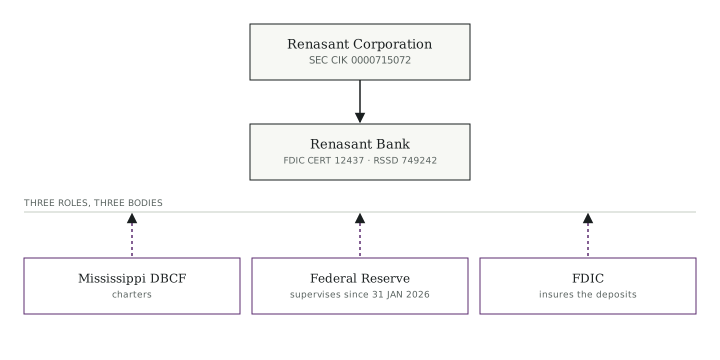
Three bodies, three roles
The question “who regulates this bank” collapses three different jobs into one word, and the registers keep them apart. The state granted the charter. The Federal Reserve is the primary federal regulator. The FDIC insures the deposits. Those are three bodies doing three things, and no one of them substitutes for another.
The confusion is easy to fall into, because the FDIC is the body whose register carries most of these fields, and a reader who takes the register’s publisher for the bank’s supervisor will get a plausible, wrong sentence out of it. The register itself is careful about this: the chartering agent, the class of the institution and the primary federal regulatory agency are three separate fields with three separate values, and the insurance date is a fourth. Reading them as one composite answer is the error, not reading the register.
The register states the class and the regulator as two fields: the bank is a state member bank, and its primary federal regulator is the Federal Reserve.
FDIC INSTITUTION REGISTER · READ 22 SEP 2026 · BKCLASS: SM · REGAGNT: FED · api.fdic.gov
The annual report names the same body in a sentence rather than a field: “The Federal Reserve serves as the Bank’s primary federal banking regulator.”
FORM 10-K · FY 2025 · 0000715072-26-000017 · sec.gov
Insurance is the third role and it has the oldest date on it. The register carries an insurance date of January 1, 1934, and that field does not move.
FDIC INSTITUTION REGISTER · READ 22 SEP 2026 · INSDATE: 01/01/1934 · api.fdic.gov
Why the answer has a date attached
The class and the regulator are current values, not permanent ones, and the structure register records the moment they changed. On January 31, 2026 it logs three changes against this charter on the same day: the institution became a member of the Federal Reserve System, its class changed, and its primary regulatory agency changed. [2]
FDIC STRUCTURE REGISTER · EFFECTIVE 31 JAN 2026 · CERT 12437 · api.fdic.gov
The registers record that the change happened and when. They do not record why, and this piece does not supply a reason, because no document read for it states one. The practical consequence is that any sentence naming this bank’s federal supervisor is only as good as the date beside it. A statement written before that day and read after it is not a rounding error; it names the wrong agency.
The holding company, and what the SEC knows
Above the charter sits a separate legal person. Renasant Corporation files with the Securities and Exchange Commission under CIK 0000715072, trades on the New York Stock Exchange under the ticker RNST, is incorporated in Mississippi, and has an employer identification number of 64-0676974 — which the SEC’s own submissions record stores without its hyphen, as 640676974. [5]
SEC SUBMISSIONS RECORD · READ 22 SEP 2026 · CIK 0000715072 · data.sec.gov
That is the split worth holding on to. The FDIC register describes a chartered, insured bank. The SEC record describes a filer with a ticker, an exchange and a state of incorporation. The two describe different entities, and a fact taken from one of them cannot be attached to the other without saying so.
The split also decides which register can answer which question. Anything to do with the charter, the class, the insured status or a dated change of structure is asked of the FDIC. Anything to do with what has been filed with the securities regulator, what the company is called there, where it is incorporated and what totals it has tagged is asked of the SEC. Neither register is a summary of the other, and where both of them carry a field with the same name — an asset total, for example — the two values are answers to two different questions and are published on two different schedules.
Twenty-three subsidiaries, twelve of them trusts
The holding company publishes its family tree once a year, as exhibit 21 to the annual report. The exhibit lists twenty-three subsidiaries with the jurisdiction each is organized under. The bank is the first entry and is organized in Mississippi; the list also carries entries such as “Park Place Capital Corporation – Tennessee” and “Continental Republic Capital, LLC – Louisiana”. [4]
FORM 10-K EXHIBIT 21 · FY 2025 · rnst12312025ex21_subsidiar.htm · sec.gov
Twelve of the twenty-three are trusts organized in Delaware or Connecticut, and ten of those twelve carry the words “Statutory Trust” in their names — “PHC Statutory Trust I – Connecticut” and “The First Bancshares Statutory Trust II – Delaware” among them.
FORM 10-K EXHIBIT 21 · FY 2025 · rnst12312025ex21_subsidiar.htm · sec.gov
What those trusts are for is the obvious next question, and the exhibit does not answer it. Exhibit 21 states a name and a jurisdiction per line and nothing else. Where a subsidiary entered the group through a transaction, it is the filings for that transaction that say so, not this exhibit — which is the route the merger paper trail takes. The exhibit is also a list of what the company chose to list; nothing here treats it as an exhaustive inventory of everything the group holds.
Three identifiers, three registers
Moving between these registers is a matter of carrying the right number. There are three, they belong to different systems, and none of them can be guessed from another.
| Identifier | Value | Register | What that register answers |
|---|---|---|---|
| FDIC certificate | 12437 | FDIC institution and structure registers | The name, city and state of the bank; who granted the charter; the class; the primary federal regulator; the insurance date; and every structure change with its own effective date. |
| Federal Reserve RSSD | 749242 | The Federal Reserve’s numbering of the institution; the number is also carried as a field in the FDIC record | Which institution is meant inside the Federal Reserve’s system. The same bank, a different numbering scheme. |
| SEC CIK | 0000715072 | EDGAR, the SEC submissions record and the XBRL company-concept endpoint | What the holding company has filed and when; its ticker and exchange; its state of incorporation; its employer identification number; and its tagged financial totals. |
FDIC INSTITUTION REGISTER · READ 22 SEP 2026 · api.fdic.gov — SEC SUBMISSIONS RECORD · CIK 0000715072 · data.sec.gov
The Federal Reserve identifier of this bank is 749242, and it is the FDIC record that hands it over: the institution register carries the number in a field of its own.
FDIC INSTITUTION REGISTER · READ 22 SEP 2026 · FED_RSSD: 749242 · api.fdic.gov
Two totals that are not the same number
The clearest test of whether the bank and the holding company have been kept apart is to ask each of them for its total assets on the same day. At June 30, 2026 the holding company reported $27,004,999,000 in its tagged data, and the bank-level figure in the FDIC register for the same report date was $26,986,725 thousand — the register states its amounts in thousands. [6]
SEC XBRL · us-gaap:Assets · 30 JUN 2026 · CIK 0000715072 · data.sec.gov — FDIC INSTITUTION REGISTER · api.fdic.gov
Two registers, one date, two figures. Neither is a correction of the other, and neither should be quoted in place of the other. The rest of this publication follows that rule: a figure is labeled with the entity it belongs to, the register it came from and the report date it carries, and where the difference matters it is shown rather than smoothed. The mechanics of how the bank-level number reaches the register are the subject of a separate piece on the quarterly Call Report, and the shape of the holding company’s own filing is set out in the piece on what a 10-K contains.
What the registers do not record
Three limits are worth stating plainly, because they are the edges of what this page can say. The registers do not record a motive for the January 2026 change of class and regulator, so no motive is offered. Exhibit 21 does not state what any subsidiary does, so nothing here says what a statutory trust is for in this particular group. And no field in any of these records speaks to the condition, the safety or the prospects of the institution; Charterbend does not read them for that and does not publish such a reading.
What is left is a structure that can be checked by anyone, one number at a time: a certificate for the bank, an RSSD for the same bank in another system, a CIK for the company above it, and a dated field for every attribute that can move. Every claim on this page is one query away from its own proof, and the queries are printed beside the sentences rather than at the bottom of the page. The full register of documents this publication cites is at the source register, and the dated events behind these changes are listed in the record.
Sources
- FDIC BankFind, institution register, certificate 12437. CERT 12437 api.fdic.gov
- FDIC BankFind, structure-change register, certificate 12437. CERT 12437 api.fdic.gov
- Renasant Corporation, annual report on Form 10-K for the year ended December 31, 2025. 0000715072-26-000017 sec.gov
- Exhibit 21, subsidiaries of the registrant, to that annual report. rnst12312025ex21_subsidiar.htm sec.gov
- SEC EDGAR submissions record for the filer. CIK 0000715072 data.sec.gov
- SEC XBRL company concept, us-gaap:Assets. CIK 0000715072 data.sec.gov
Charterbend does not provide investment advice. It does not rate, recommend or value any security or institution, and nothing here is an offer or a solicitation to buy or sell anything.