 Charterbend
Front sheet · Analysis · The Footprint
The Footprint
Where Renasant Bank operates
A branch network is a public fact with a date on it. Read on September 22, 2026, the register lists 266 offices in six states, and three quarters of them sit in three.
The map on a bank’s website is a design object. The register is a file. This piece describes one network entirely from the file: how many offices it contains, which states they are in, how many arrived on a single day, and what the register logs across the whole life of the charter. Nothing below is drawn from a corporate map, a press summary or a directory site, and where the file is silent, this piece is silent too.
The file in question is the FDIC’s location register, queried by certificate number. The certificate is 12437, and the institution it belongs to is Renasant Bank, of Tupelo, Mississippi.
FDIC INSTITUTION REGISTER · CERT 12437 · api.fdic.gov
The count, and where it comes from
The register lists 266 offices for certificate 12437. That is the number of office records on file on the day of reading, not an estimate and not a rounded figure from a company document.
FDIC LOCATION REGISTER · CERT 12437 · api.fdic.gov
The same system answers the question a second time from a different direction. The institution-level record carries its own office field, and that field returns 266 as well. Counting the records and reading the summary field are two different operations on two different endpoints, and they agree.
FDIC INSTITUTION REGISTER · CERT 12437 · api.fdic.gov
Six states
Every office record carries a state, and for this certificate six states appear: Mississippi, Georgia, Alabama, Florida, Tennessee and Louisiana.
FDIC LOCATION REGISTER · CERT 12437 · api.fdic.gov
Counted from the register response, Mississippi holds 89 offices, Georgia 73 and Alabama 37; Florida holds 26, Tennessee 21 and Louisiana 20. The six counts are set out below in order, and they add to the 266 the register reports — a sum worth performing rather than assuming, because a state distribution that does not reconcile to the total is a sign that something was filtered out on the way.
FDIC LOCATION REGISTER · CERT 12437 · api.fdic.gov
| State | Code | Offices |
|---|---|---|
| Mississippi | MS | 89 |
| Georgia | GA | 73 |
| Alabama | AL | 37 |
| Florida | FL | 26 |
| Tennessee | TN | 21 |
| Louisiana | LA | 20 |
| Six states | Total | 266 |
FDIC location register, certificate 12437, read September 22, 2026. Counted from the saved register response; the total was checked against the institution-level office field. api.fdic.gov
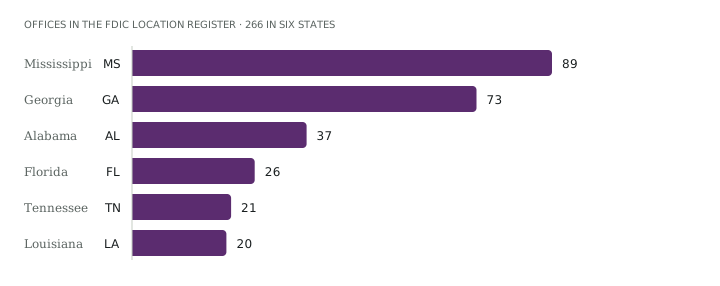
Three states hold three quarters of the records
The three highest counts belong to Mississippi, Georgia and Alabama, and together they come to 199 — three quarters of the 266. The remaining three states, Florida, Tennessee and Louisiana, account for 67 between them.
FDIC LOCATION REGISTER · CERT 12437 · api.fdic.gov
Two things are worth saying about that proportion, and one of them is a warning. The first is arithmetic: 89 plus 73 plus 37 is 199, and 199 out of 266 is a little under three quarters, which is why this piece says three quarters and not two thirds. The second is editorial: a concentration figure describes where records are, and nothing else. It is not a statement about where a bank’s business is, where its customers are, or what it intends to do next. The register holds offices, and the counting stops there.
One day in April 2025
A network of this shape did not accumulate evenly. The structure register logs 117 offices entering the network on a single day, April 1, 2025, each one recorded with the change code for a branch acquired in a merger or consolidation.
FDIC STRUCTURE REGISTER · CERT 12437 · api.fdic.gov
That is 117 of the 266 records on file today arriving through one event — although the two figures are separated by nearly eighteen months of further change, and the register does not carry a field saying which of today’s records came from that day. What it does carry is the event, dated, one row per office. The documents around that transaction, and the order in which they appeared, are followed in the First Bancshares merger, in the documents.
The same register logs six branch closings on that same day, and further closings through 2025, including five effective August 1, 2025. The register records that offices closed and when. It does not record why any of them closed, and no reason is supplied here.
FDIC STRUCTURE REGISTER · CERT 12437 · api.fdic.gov
The whole life of the charter
The structure register is not limited to recent years. Across the charter’s whole life it logs 271 branch acquisitions, 90 branch closings and 62 branch openings — three tallies that describe how offices have entered and left this network since the file was opened.
FDIC STRUCTURE REGISTER · CERT 12437 · api.fdic.gov
| Event, as the register codes it | Records | Period covered |
|---|---|---|
| Branch acquired in merger, consolidation or failure | 271 | The charter’s life |
| Branch closing | 90 | The charter’s life |
| Branch opening | 62 | The charter’s life |
| Branch acquired in merger, consolidation or failure | 117 | Effective April 1, 2025 |
| Branch closing | 6 | Effective April 1, 2025 |
| Branch closing | 5 | Effective August 1, 2025 |
FDIC structure register, certificate 12437, read September 22, 2026. Counted from the register response rather than from any summary of it. api.fdic.gov
The three life-of-charter tallies do not net to 266 and are not meant to. Acquisitions, openings and closings are events, spread across more than a century of file history and across predecessor names; the 266 is a count of records standing today. Subtracting one set from the other produces a number that means nothing, which is exactly the sort of arithmetic a reader should refuse to perform on a register.
One record, to show what a record is
Abstractions about counts are easier to check against a single row. The register carries an office in Homerville, Georgia, with the state code GA — one line in a file of 266, with a city, a state and a service level of its own.
FDIC LOCATION REGISTER · CERT 12437 · api.fdic.gov
That is what every one of the counts above is made of. Not a pin on a map and not a marketing region: a row, with fields, produced by a federal register, retrievable by anyone with the certificate number and returned in the same form to everyone who asks.
Which count to cite
A reader comparing this page with a figure published elsewhere will sometimes find a different number, and there are two ordinary reasons for that, neither of which requires anyone to be wrong. The first is the date: the register answers on the day it is asked, and this page was asked on September 22, 2026. The second is the population: the FDIC’s annual deposit survey counts a different set of offices from the live register, and its own instructions remove some of them, loan production offices among them. That mechanism is set out in the FDIC Summary of Deposits, explained, and it is the reason a register total and a survey total can differ without either being incorrect.
The practical rule this publication follows is to cite the register when the question is “how many office records exist today,” to cite the survey when the question is “where were the deposits on June 30,” and to attach the date to both.
What the register does not say
Three limits apply to this piece, and they are limits of the source, not of space.
The register records offices. It does not record that an institution operates in, covers or attends to a state, a city or a community, and no such wording appears above. An office record is a location on file, and the honest sentence stops at the record.
No comparison is drawn with the institution’s own published map of its locations. That map was not readable when this piece was built, and a comparison between a document that was read and one that was not is not published here.
No inference is drawn from the opening and closing tallies about expansion, retreat, strategy or intent. Those tallies are counts of change codes with effective dates. Turning them into a direction of travel would require documents this piece has not read, and would be an opinion wearing a number’s clothes.
What remains is a network described exactly as a federal register describes it: 266 office records, six states, three of them holding 199 of the records, 117 records added on one day in 2025, and a century of events behind the file. Each of those figures is re-checked quarterly, and the date at the top of this page says when it was last done.
Sources
- FDIC location register, office records for one certificate. CERT 12437 api.fdic.gov
- FDIC institution register, institution-level record. CERT 12437 api.fdic.gov
- FDIC structure register, change records for one certificate. CERT 12437 api.fdic.gov
Charterbend does not provide investment advice. It does not rate, recommend or value any security or institution, and nothing here is an offer or a solicitation to buy or sell anything.