 Charterbend
Front sheet · Analysis · The System
The System
How a bank merger is approved
Which federal agency approves a bank merger is not settled by the size of the transaction. It is settled by one line of statute, and the line asks a single question: what kind of charter the surviving bank will hold.
Coverage of bank mergers tends to reach for size. A transaction is described as big enough to attract scrutiny, or small enough to pass quietly, as though the federal government allocated its attention by dollar volume. The statute that actually assigns the reviewing agency does not mention dollars at all. It asks what the acquiring, assuming or resulting bank is going to be, sorts the answer into one of three charter classes, and hands the file to the agency attached to that class.
This page reads that line, then the parallel line that governs a holding company acquiring a bank, then the two clocks that run inside both procedures. It closes with a case in which the answer to the charter question changed between one year and the next — which means the answer to “which agency” changed with it.
Two statutes, two tracks
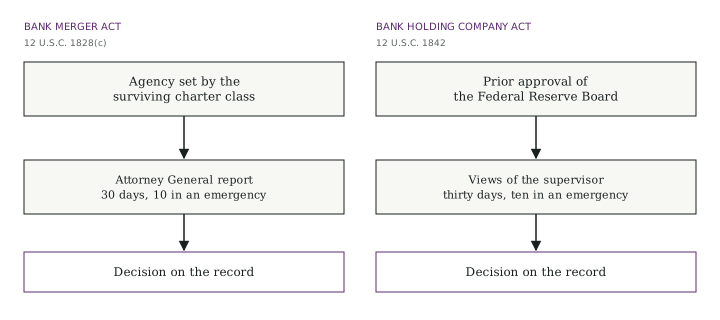
A transaction that the press calls one merger is often two procedures in the public record. One track concerns the banks themselves: an insured bank merging with, absorbing or assuming the liabilities of another. The other concerns ownership: a holding company acquiring a bank or another holding company. They are written in different sections of Title 12, they are addressed to different applicants, and only the first of them is decided by the charter class of the surviving bank.
The line that assigns the agency
The operative language of 12 U.S.C. 1828(c) names all three cases in one sentence: “the Comptroller of the Currency if the acquiring, assuming, or resulting bank is to be a national bank or a Federal savings association; the Board of Governors of the Federal Reserve System if the acquiring, assuming, or resulting bank is to be a State member bank; and the Corporation if the acquiring, assuming, or resulting bank is to be a State nonmember insured bank or a State savings association”.
UNITED STATES CODE · 12 U.S.C. 1828(c) · law.cornell.edu
Two notes on that quotation before the substance. It omits the enumeration markers the printed section uses — the (A), (B), (i) and (ii) that break the sentence into subparagraphs — without altering a word of the text between them. And it leaves the statute’s own vocabulary alone: where the section says “the Corporation”, this page says “the Corporation” rather than substituting a name the section does not use at that point.
| Case | If the resulting bank is to be | The responsible agency, in the statute’s words |
|---|---|---|
| 1 | a national bank or a Federal savings association | the Comptroller of the Currency |
| 2 | a State member bank | the Board of Governors of the Federal Reserve System |
| 3 | a State nonmember insured bank or a State savings association | the Corporation |
United States Code, 12 U.S.C. 1828(c), read September 22, 2026. Terms are the statute’s own; the enumeration markers of the original are omitted. law.cornell.edu
What the line does not say
It is worth stating the absences, because they are where most assumptions live. The sentence contains no dollar figure and no size test. It does not ask how many offices change hands, how many deposits move, or what the transaction is worth. It does not ask which agency supervised either bank before the transaction. It asks one question about the future — what the acquiring, assuming or resulting bank is to be — and the tense is the whole mechanism. The class that governs is the class after the transaction, not the class before it.
UNITED STATES CODE · 12 U.S.C. 1828(c) · law.cornell.edu
The competitive report, and its clock
Whichever agency the line selects, the same section requires it to go outside the banking agencies before it acts. It must “request a report on the competitive factors involved from the Attorney General of the United States”.
UNITED STATES CODE · 12 U.S.C. 1828(c) · law.cornell.edu
That request carries a clock written into the section itself. The report is to be furnished “not later than 30 calendar days after the date on which the Attorney General received the request; or not later than 10 calendar days after such date, if the requesting agency advises the Attorney General that an emergency exists requiring expeditious action”.
UNITED STATES CODE · 12 U.S.C. 1828(c) · law.cornell.edu
Thirty days, or ten where the requesting agency states that an emergency requires expeditious action. The emergency route is not an informal courtesy: it is a condition the requesting agency must assert, and the shorter clock follows from the assertion.
The holding company track
The second track is stated as a prohibition rather than as a procedure. Under 12 U.S.C. 1842, a company may not acquire a bank without the Federal Reserve Board’s prior approval; the section opens by declaring that “It shall be unlawful, except with the prior approval of the Board”.
UNITED STATES CODE · 12 U.S.C. 1842 · law.cornell.edu
On that track the Board is also required to consult, and the party consulted depends on the bank in question: the Comptroller of the Currency or the State supervisor, who has thirty days to give views, or ten in an emergency — “within thirty calendar days of the date on which notice is given, or within ten calendar days of such date”.
UNITED STATES CODE · 12 U.S.C. 1842(b) · law.cornell.edu
The two clocks run for the same number of days and are written differently, and that detail is not decoration. Section 1828(c) prints the digits — 30 and 10. Section 1842(b) spells the numbers out — thirty and ten. A quotation that moves the digit form from one section into the other states a true number in words the section does not contain, and it reads as sound until someone opens the page. One draft of this publication’s own file did exactly that and was caught by the excerpt column of its dossier, which exists for no other purpose.
| Track | Section | Who is asked | Ordinary period | Shorter period |
|---|---|---|---|---|
| Merger of insured banks | 12 U.S.C. 1828(c) | the Attorney General of the United States, on competitive factors | 30 calendar days | 10 calendar days |
| Acquisition by a company | 12 U.S.C. 1842(b) | the Comptroller of the Currency or the State supervisor, for views | thirty calendar days | ten calendar days |
United States Code, 12 U.S.C. 1828(c) and 12 U.S.C. 1842(b), both read September 22, 2026. The number forms differ because the sections differ; each is reproduced as its own section prints it. law.cornell.edu
A case in which the answer changed
The rule is abstract until a charter moves. One did, on a date the register records. Certificate 12437 held a state non-member charter until January 31, 2026, when the institution became a state member bank; the structure register logs the membership and the change of class with that effective date.
FDIC STRUCTURE REGISTER · CERT 12437 · api.fdic.gov
The institution-level record carries the result of that change as two plain fields: the class is "SM" and the primary regulator is "FED".
FDIC INSTITUTION REGISTER · CERT 12437 · api.fdic.gov
The same certificate had been through a merger before that date. It closed effective April 1, 2025, just under ten months before the change of class.
FORM 8-K · CIK 0000715072 · sec.gov
Laid against the statute, those two dates have a consequence that is easy to describe and easy to overstate. The line in 1828(c) selects the agency by the class the resulting bank is to hold. On April 1, 2025 the class attached to this certificate was one thing; from January 31, 2026 it is another. A rule that reads off a charter class will therefore not necessarily give the same answer for a transaction completed in 2025 and a transaction completed after the change — because the input to the rule is different, not because the rule moved.
What this page does not conclude
Charterbend does not state which agency in fact approved the 2025 transaction. The approval documents for it were not read, and a conclusion drawn from a statute and a date is an inference, not a filing. The rule is stated above, the class on each date is stated above, and the inference is left where it belongs: with the reader, undrawn.
Nor does this page assess the approval. Whether any review was correct, swift, thorough or otherwise is not a question a document-reading publication can answer from the documents it has read, and no adjective above is doing that work.
And nothing here forecasts a future transaction. There is no transaction pending in these sources, no application recorded in them, and no prediction offered. What the statute supplies is a rule with an input; what the register supplies is the value of that input on two dates. The structure behind the charter — who granted it, who supervises it, who insures the deposits — is set out in the structure of the corporation, and the paper trail of the 2025 transaction, document by document, is followed in the First Bancshares merger, in the documents.
The useful residue is small and durable. Size does not choose the agency. Charter class does, and the class is a fact with an effective date, recorded in a register anyone can query, which means the question “who approves this” always has a second half: as of when.
Sources
- United States Code, banking, merger transactions. 12 U.S.C. 1828(c) law.cornell.edu
- United States Code, acquisition of bank shares or assets. 12 U.S.C. 1842 law.cornell.edu
- FDIC structure register, change records for one certificate. CERT 12437 api.fdic.gov
- FDIC institution register, institution-level record. CERT 12437 api.fdic.gov
- Renasant Corporation, press release on completion of the merger, filed as an exhibit. CIK 0000715072 sec.gov
Charterbend does not provide investment advice. It does not rate, recommend or value any security or institution, and nothing here is an offer or a solicitation to buy or sell anything.